Aftermath
Transformation Does Not Cancel the Damage
“But I’m different now.”
Good.
The people I hurt still got hurt.
Becoming a new man does not retroactively erase what the old man broke.
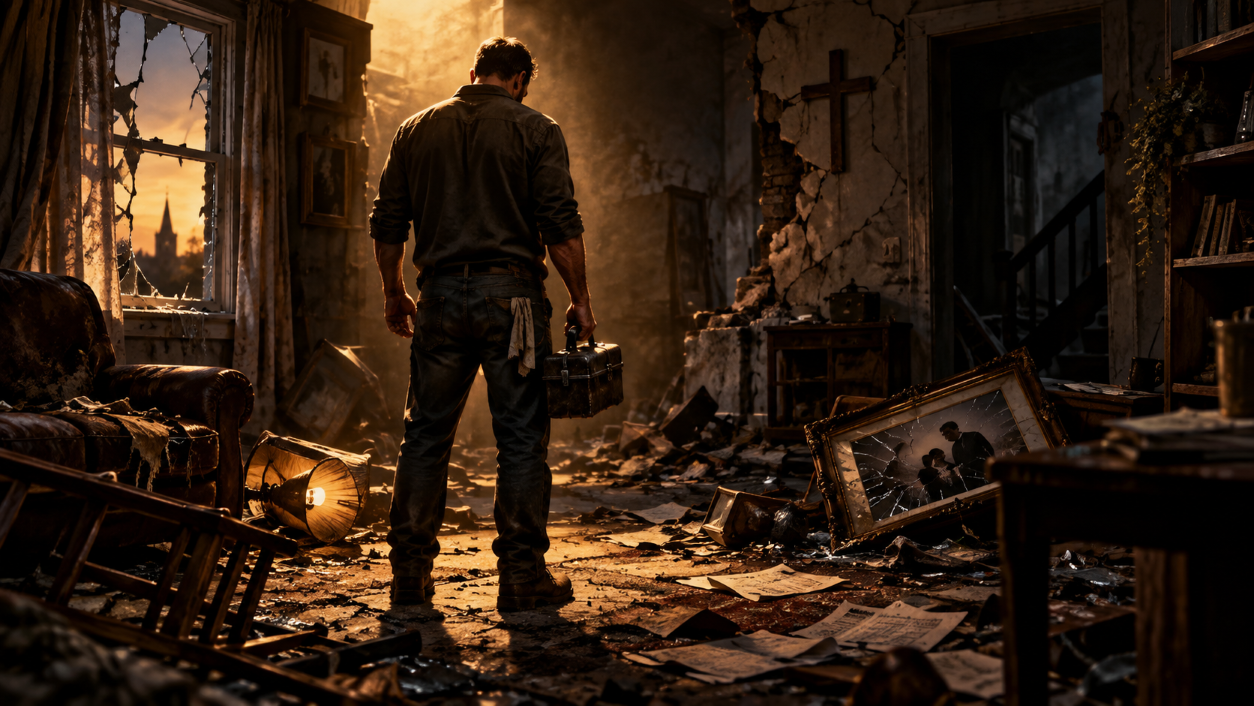
Conversion changes who I am.
It does not erase what I did.
There is a dangerous place in transformation where I can begin using my new identity as insulation from my old responsibility.
That wasn't who I really was.
God changed me.
I've moved on.
I'm not that guy anymore.
Maybe all true.
But somebody else may still be carrying a bill I created.
And becoming a better man does not make that bill disappear.
THE NEW MAN STILL INHERITS THE OLD MAN'S DAMAGE
We love the language of transformation.
New creation.
New heart.
New mind.
New life.
And it is true.
“If anyone is in Christ, he is a new creation. The old has passed away; behold, the new has come.”
— 2 Corinthians 5:17
But being made new does not mean pretending nothing happened before I got here.
The new man may still have old debts.
Broken trust.
Words that cannot be unheard.
Promises abandoned.
Money never repaid.
People who learned to brace themselves when I entered the room.
Relationships forced to survive versions of me I no longer recognize.
God may have redeemed the man.
That does not mean everyone around him escaped the wreckage.
And if I use grace to avoid responsibility, I have misunderstood grace entirely.
REMORSE IS NOT REPAIR
Feeling terrible about what I did may be sincere.
It still isn't an amend.
Regret can happen entirely inside of me.
Repair requires movement toward what I damaged.
Zacchaeus understood this.
When Jesus entered his life, his response was not merely:
I'm different now.
He started talking about restitution.
“If I have defrauded anyone of anything, I restore it fourfold.”
— Luke 19:8
Transformation produced responsibility.
He didn't use his encounter with Christ as proof that the past no longer mattered.
His conversion changed what he was willing to do about the past.
That is different.
Sometimes the most spiritual thing I can do is not explain how much I've changed.
It is to ask:
What can I make right?
I DON'T CONTROL WHAT HAPPENS NEXT
This is where repair gets uncomfortable.
Because making amends is not purchasing absolution.
I can confess it.
Own it.
Repay it.
Correct it.
Change my behavior.
And the person I hurt may still not trust me.
They may not forgive me when I want them to.
They may not restore the relationship.
They may not believe I've changed yet.
And I do not get to demand that they do.
Otherwise my "amends" is just another attempt to control the outcome.
Scripture doesn't tell me to manufacture somebody else's response.
It tells me what belongs to me.
“If possible, so far as it depends on you, live peaceably with all.”
— Romans 12:18
So far as it depends on me.
That is my side of the street.
Not forcing reconciliation.
Not defending myself.
Not explaining why they should understand.
Not asking them to make me feel better about what I did to them.
Just taking responsibility for what is mine.
There is humility in admitting I was wrong.
There is another level of humility in realizing that my transformation does not require anyone else to pretend the damage never happened.
Maybe I really am different now.
Thank God.
But the proof cannot only be that I stopped creating the same wreckage.
Sometimes the proof is that I am finally willing to walk back into what I left behind and ask:
What still needs to be repaired?
Because grace does not make responsibility unnecessary.
Grace finally makes me strong enough to face it.
