The Receipt
You Don’t Get to Decide When the Debt Feels Paid
I can repay money.
I can replace what I broke.
I can correct a lie.
I can change my behavior.
But I cannot set somebody else’s healing schedule.
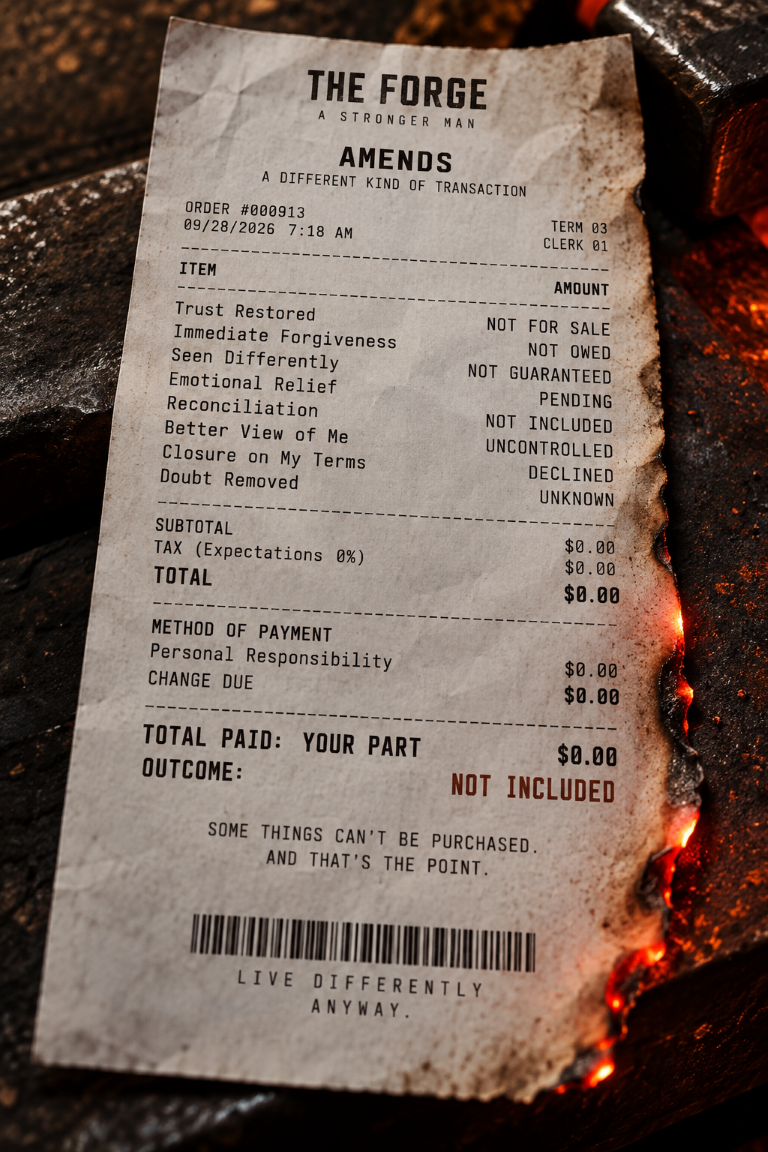
There is a strange temptation that shows up after I finally start doing the right thing.
I expect credit for it.
Maybe I would never say that out loud, but somewhere underneath the apology, the repayment, the changed behavior, and the effort to make things right, a question can start forming:
How long are you going to hold this against me?
I admitted it.
I apologized.
I changed.
What else do you want from me?
And just like that, repentance can become another transaction.
I paid.
Now where is my receipt?
The problem is, an amend does not buy absolution.
It does not purchase trust.
It does not guarantee reconciliation.
Paul described real repentance like this:
“See what this godly sorrow has produced in you: what earnestness, what eagerness to clear yourselves...”
— 2 Corinthians 7:11
Real remorse moves.
It repairs.
It corrects.
It changes direction.
But even sincere change does not give me authority over what happens inside the person I hurt.
I can become trustworthy.
I cannot demand trust.
I can become safe.
I cannot decide when someone else feels safe around me.
That part belongs to them.
And maybe that feels unfair.
But if it took me years to damage something, why should I expect somebody else to heal from it in a few weeks?
Maybe they did not stop trusting me because of one moment.
Maybe it was a hundred moments.
A hundred broken promises.
A hundred disappointments.
A hundred times they believed me and wished they had not.
Then I change, and suddenly I am frustrated because they are still cautious.
But I taught them caution.
Warren Buffett has said:
“It takes 20 years to build a reputation and five minutes to ruin it.”
That applies to more than business.
Trust can disappear quickly.
It usually comes back slowly.
And it does not come back because my apology was powerful.
It comes back through consistency.
That is where this gets uncomfortable.
Sometimes I do not actually demand forgiveness.
I just demand reassurance.
I say things like:
I guess nothing I do is ever going to be enough.
Or:
You know I’m not that person anymore.
Or:
How long am I supposed to keep proving myself?
But maybe the better question is:
Why would I ever stop living like the man I claim I have become?
If honesty, humility, sobriety, faithfulness, and responsibility are only things I do until everybody believes me again, then I am still performing.
They are supposed to be my life now.
That means I keep doing right even when nobody claps.
I keep my word even when people still expect me to break it.
I stay patient when someone is still angry.
I accept that forgiveness and trust are not the same thing.
Someone may forgive me and still keep a boundary.
Someone may love me and still decide they cannot walk closely with me.
That hurts.
But my repentance does not give me the right to force restoration.
Scripture says:
“Let us not become weary in doing good...”
— Galatians 6:9
Sometimes doing good means continuing to live differently without demanding that anyone reward me for it.
That may be the real proof.
Not the apology.
Not the speech.
Not the emotional moment.
Tuesday.
Then Wednesday.
Then another Tuesday six months later.
Same integrity.
Same humility.
Same man.
No announcement.
No receipt.
Just a changed life.
Make the amend.
Repair what you can.
Tell the truth.
Change the behavior.
Then release the outcome.
You are responsible for your repentance.
They are allowed to be responsible for their healing.
And if the change is real, eventually you stop needing to prove it with words.
You just live it.
